Quick Summary
Google stopped supporting Chrome Sign Builder in kiosk mode after ChromeOS 150 in July 2026. So you'll need a replacement for any screen that's still running it. For schools that want to keep their Google Slides and add templates, scheduling, and staff access, we recommend Rise Vision. It works on compatible Chromeboxes, and the 14-day free trial lets you try it on a screen you already use. No credit card required.
|
Software |
Best For |
Price |
Free Option |
|
Rise Vision |
Templates, scheduling, and shared editing on your current Chromeboxes |
Basic: $11 per display monthly, or $119 per display annually, for education and nonprofits |
14-day free trial, no credit card |
|
Google Slides web kiosk (DIY) |
One unscheduled slideshow per screen |
No software fee (each device needs a ChromeOS license) |
Free |
|
Carousel Digital Signage |
Rollouts of 10 or more screens |
$25 per player per month, 10-player minimum |
None advertised |
Replacing a Free Tool You Hadn’t Planned to Replace
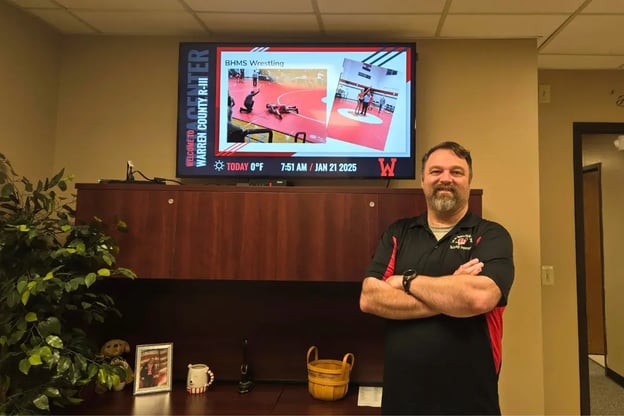
Warren County R-3 in Missouri had been using Chrome Sign Builder for nearly a decade when Google announced it was going away.
"The trigger event was the notification from Google that it was completely going away," says Technology Director Ron Greer.
And they're not alone. We hear the same thing from a lot of schools. Chrome Sign Builder was free, simple, and already doing the job, so replacing it wasn't exactly something they'd budgeted or planned for.
Now there's a more practical question to answer: what do you replace it with, and can you keep using the hardware you already have?
That's what we'll help you figure out in this guide.
Why Listen to Us?
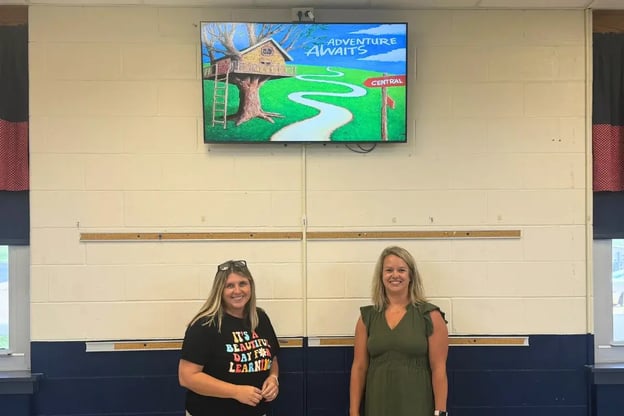
Central R-3 in Missouri moved its entire signage setup from Chrome Sign Builder to Rise Vision in one go. The district's screens now reach over 2,000 students across four campuses.
Saline Middle School in Michigan made the same switch, and it's running Rise Vision on its existing Chromeboxes. In all, we've helped 12,300+ organizations communicate, teach, and collaborate better since 1992. So we know what a Sign Builder migration takes, and this guide walks you through it.
Chrome Sign Builder End of Life: The Full Timeline
Chrome Sign Builder reached its end of life in July 2026. ChromeOS 150 was the last version to support it in kiosk mode, with devices on the Long-term Support (LTS) channel given until April 2027. The shutdown followed several years of changes:
- October 2021: Google extended Chrome app support for businesses and schools until at least January 2025. It later pushed that deadline back.
- July 2025: Google began phasing out Chrome apps. ChromeOS 138 disabled them in kiosk mode by default, though IT teams could temporarily turn them back on through the Admin console.
- July 2026: ChromeOS 150 became the final release to support kiosk Chrome apps, including Sign Builder.
- August 2026: With ChromeOS 151, kiosk Chrome apps stopped working, even if the temporary setting was still enabled.
- April 2027: Support for kiosk Chrome apps ends on the LTS channel.
- October 2028: The remaining LTS support ends, completing the phaseout of Chrome apps across ChromeOS.
If your Chromeboxes have updated to ChromeOS 151 or later, they can no longer run Sign Builder. When a device tries to open it, your audience sees a message telling them to contact IT in place of your announcements.
Devices still on a supported LTS version have until April 2027. After that, Sign Builder will no longer be available to install or configure.
Why Consider Chrome Sign Builder Alternatives?
The districts we talk to started looking for an alternative because of Google's deadline. Now that Sign Builder is no longer supported, schools are taking a closer look at what they actually need from their screens. Once they do, some describe their old setup as "just a slideshow," and these three gaps stand out:
- No design tools: You build every slide somewhere else first.
- Updates run through IT: You upload schedules in the Admin console, so every change goes through whoever manages the devices.
- ChromeOS only: Windows PCs, Android players, and other hardware need a separate system.
The wish lists we hear are short, too, with requests like letting building staff update their own screens, Google sign-in, and an easy setup.
Rise Vision: The Best Chrome Sign Builder Alternative
Rise Vision combines digital signage, screen sharing, and emergency alerts into one platform, enabling seamless teaching, engaging communication, and instant emergency notifications. Our easy-to-use software works with your existing hardware, including the Chromeboxes you currently have.
So you can start with our 14-day free trial, and you won't need a credit card. That way, you'll see your content play on a Chromebox before you spend anything. When you're ready to buy, our pricing is simple and transparent. Basic costs $11 per display per month for schools, colleges, and nonprofits. Businesses pay $12, and new customers get a 30-day money-back guarantee.
Everything Sign Builder left out comes standard on the Basic plan:
- 750+ templates: Save hours of content creation time every week with 750+ professionally designed, animated, and customizable templates, plus our AI presentation design tool.
- Google Slides and popular integrations: Display your Google Slides presentations directly on your screens, and automatically pull content from Canva, YouTube, local weather, and more.
- Centralized content control: Schedule and update content across all your displays from a single platform, and set exactly when each presentation plays and repeats.
- Shared editing: Delegate the management of your digital signage to anyone in your organization, with unlimited users and roles like Content Editor.
- Remote monitoring: See a screenshot of what each display is showing right now, from your desktop or phone.
- Offline playback: Rise Player stores your content locally, so your displays keep running when the network drops.
- Fast support: Get help within one business hour by phone, email, or remote desktop support, plus free training.
That shared editing matters more than you'd think. At Central R-3, Matt Burgess used to edit every Sign Builder screen himself. "Now we just have other users out there that have access to their individual buildings. So that took a lot off my plate," he says. The district now runs Rise Vision across four campuses that reach over 2,000 students.
Need more? On our Advanced plan, you get instant visual emergency alerts from leading Common Alerting Protocol (CAP) systems like Raptor, CrisisGo, Singlewire, and Alertus. For schools, Advanced costs $138 per display per year. And with Enterprise, you can access wireless screen sharing from any device, plus single sign-on through Google Workspace.
Chrome Sign Builder vs. Rise Vision: Side-by-Side Comparison
|
Feature |
Chrome Sign Builder |
Rise Vision |
|
Status |
ChromeOS 150 was the last release supporting Chrome Apps in kiosk mode |
Actively supported, with automatic software updates and SOC 2 Type 2 Attestation |
|
ChromeOS kiosk support |
Ends after ChromeOS 150; eligible LTS devices retain support until April 2027 |
Runs as a kiosk web app on compatible ChromeOS 88+ devices that still support kiosk mode |
|
Templates |
No built-in template library |
750+ animated, customizable templates plus an AI presentation design tool |
|
Content |
Web pages, images, YouTube videos and playlists, and published Google Slides |
Google Slides, web pages, images, videos, YouTube, PDFs, and integrations with 35+ services |
|
Device support |
Managed ChromeOS kiosk devices |
ChromeOS, Windows, Android, Raspberry Pi, Apple TV, BrightSign Series 4+, and more |
|
Scheduling |
Time slots, recurring schedules, end dates, and all-day schedules; configuration is exported for deployment |
Scheduling with timelines, playlists, recurring content, start and end times, and temporary overrides |
|
Offline playback |
Not documented by Google as a Chrome Sign Builder feature |
Stores supported content locally so displays can continue playing if the connection drops |
|
User management |
No built-in user roles or account hierarchy; permissions for content such as Google Slides are managed separately |
Unlimited users, configurable user roles, and account hierarchy |
|
Pricing |
No separate Chrome Sign Builder app fee; managed devices require an applicable ChromeOS management licence |
14-day free trial, then from $11 per display per month for Basic K-12 |
|
Setup |
Create a schedule, export its configuration file, and deploy it to managed ChromeOS devices |
Deploy Rise Player as a kiosk web app through Google Admin, then activate the display |
Other Chrome Sign Builder Alternatives Worth a Look
Google Slides Web Kiosk (Free)
If one slideshow per screen is all you need, Google's own guide to replacing Sign Builder shows how to skip signage software entirely. You publish a Google Slides deck to the web, then add its link as an auto-launching kiosk web app in the Admin console. There's no software fee beyond each device's ChromeOS license.
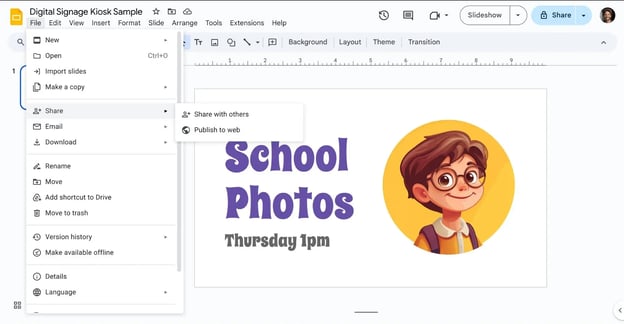
You'll give up control, though. Google notes that the Admin console can't schedule URLs, and Slides edits don't appear until the device reboots.
Comeen Play
Comeen Play is digital signage software for workplace communication, and Comeen is now part of LumApps. It runs on ChromeOS through its own app, and there's a 30-day free trial, though you'll need a quote for pricing.
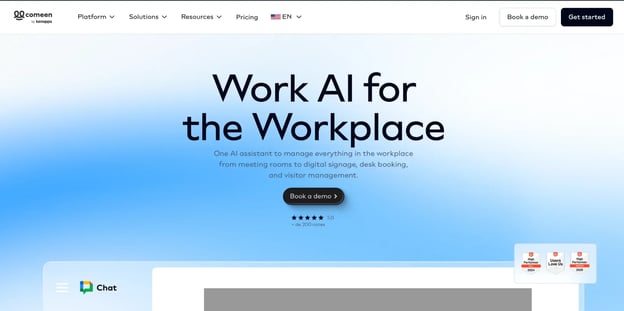
On older hardware, check your version first, because Comeen's recommended app needs ChromeOS 98 or later.
Carousel Digital Signage
Carousel supports ChromeOS deployment by kiosk URL and offers Google Slides and YouTube content options.
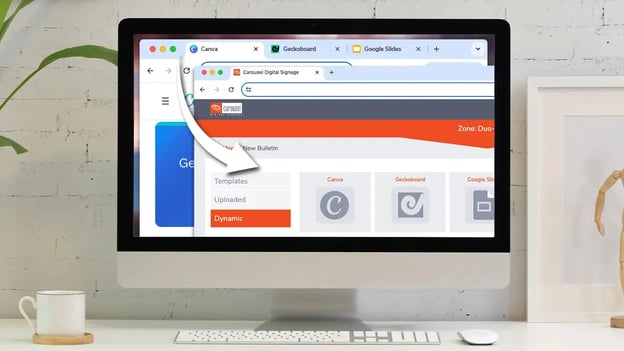
Its published Core plan is $25 per player per month with a 10-player minimum. That's a starting commitment of $250 a month at standard pricing, so it makes more sense to compare when you're managing several buildings or planning a larger rollout. K–12 pricing is available on request and may differ from the standard rate.
How to Switch From Chrome Sign Builder to Rise Vision
Do You Have to Replace Your Hardware?
Probably not. If your existing hardware is still supported, there’s a good chance you can keep using it with Rise Vision rather than replacing everything.
That’s what Farmington School District did when it moved from Chrome Sign Builder. Technology Support Specialist Jason Beffa says:
“We were able to use our existing equipment immediately.”
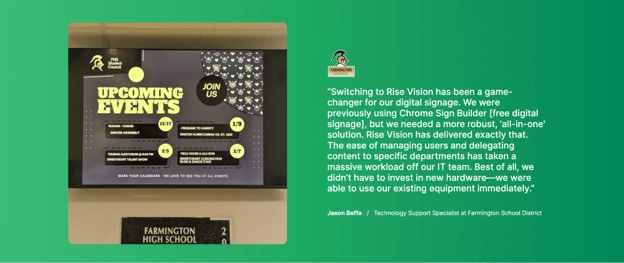
For Chromeboxes, Rise Player supports devices running ChromeOS 88 or later that are managed through Google’s Chrome Device Management and still support kiosk mode.
How long you can keep using a particular Chromebox depends on its Auto Update Expiration date. For example, Google currently lists the ASUS Chromebox 6a for automatic updates through June 2034.
Older Chromebits are a different story. Google ended automatic updates for the ASUS Chromebit CS10 in June 2020 and Central R-3 found they couldn't handle animated content anyway.
"As soon as you would throw a bunch of animated content on [the Chromebits], they would just crash and burn," says Burgess. His district now runs our recommended Rise Vision Media Players. If you'd rather bring your own hardware, our guide to Chromebit alternatives compares 10 options.
Step 1: Export Your Chrome Sign Builder Content
Make a list of what each screen currently shows, including your web pages, Google Slides, YouTube videos, and when each one is scheduled to play.
If you still have access to Chrome Sign Builder, export your schedule file first. Google says the exported file contains your content URLs, settings, and schedules, which makes it a useful reference when rebuilding everything in Rise Vision.
If you can't access it anymore, simply work through your screens and create the same inventory manually.
Step 2: Move Over Your Existing Content
You don't have to redesign everything straight away. Start by bringing over the content people already see today. For Google Slides, publish the deck to the web and add that URL to Rise Vision. You can also add compatible web pages directly, provided they use HTTPS and allow themselves to be embedded.
That's similar to how Warren County R-3 handled its move. Technology Director Ron Greer explains:
“We built a slide with the weather that ran alongside the normal Google slideshow.”
From there, his team “slowly converted informational slides into individual presentations.”
That means you can get the screens running first, then gradually replace older content with Rise Vision templates when you're ready.
Step 3: Prepare Your Chromeboxes in Google Admin
If you're keeping your existing Chromeboxes, we recommend putting your digital signage devices in their own organizational unit, or OU, so they can all use the same settings.
So:
- Create a dedicated OU called Rise Vision.
- Go to Devices > Chrome > Settings and select that OU.
- Disable Guest Mode.
- Set Sign-in restriction to allow any user to sign in.
- Set User Data to Do not erase local user data.
- Disable managed guest sessions.
- Configure your display resolution. We recommend 1920 × 1080 at 100% scale, or native resolution if you're managing screens with different resolutions.
You should also make sure Chrome Sign Builder, or any other app that tries to launch automatically, isn't assigned to the same OU.
Step 4: Add Rise Player as Your Kiosk Web App
Chrome Sign Builder depended on a Chrome App. Rise Player is deployed on ChromeOS as a web app instead, so it isn't affected by the Chrome App kiosk shutdown.
In Google Admin:
- Go to Devices > Chrome > Apps & extensions > Kiosks and select your Rise Vision OU.
- Click Add by URL and add the Rise Vision Player web app URL from Rise Vision's ChromeOS setup guide.
- Open the app settings and:
- disable Allow app to manage power
- enable Device Attributes API
- enable Web app can run offline
- Select Add Extension > Add from a custom URL.
- Enter Rise Vision's extension ID, lkfmfdclabnnmkccbfmkojbhohalhlon, and leave the source set to From the Chrome Web Store.
- Set Rise Vision Player as the auto-launch app and save your changes.
Google supports deploying websites and web apps this way in locked-down ChromeOS kiosk mode, which is also the migration path Google recommends as Chrome Apps are phased out.
Step 5: Assign Your Devices and Activate Your Screens
Finally, assign each Chromebox to the Rise Vision OU.
Once it's assigned, the device should automatically install and launch Rise Player. Follow the activation instructions that appear on screen, then connect the display to the schedule you want it to show.
From there, you can manage your content and schedules from Rise Vision instead of rebuilding and uploading a Chrome Sign Builder schedule whenever something changes.
You can also give staff their own Rise Vision access instead of routing every update through IT. For example, Content Editors can create and edit presentations, while Content Publishers can be given permission to publish changes.
Move From Chrome Sign Builder Without Starting From Scratch
Moving away from Chrome Sign Builder doesn’t necessarily mean replacing your hardware or rebuilding everything at once.
If your Chromeboxes are still supported, you can use them with Rise Player and keep showing the Google Slides and web content you already rely on. Then, once everything is running, you can gradually move to Rise Vision templates, scheduling, and other features at your own pace.
You can also give staff access to manage their own content, so every small screen update doesn’t have to go through IT.
Get free demo to see how the migration works in practice. Or, if you’re ready to try it yourself, start a 14-day free trial and test Rise Vision on one Chromebox first.
FAQs About Replacing Chrome Sign Builder
Will My Google Slides Still Work?
Yes. Rise Vision displays Google Slides presentations directly on your screens, using the same Publish to the web link that Sign Builder used. We check your deck for changes every hour, so edits show up without rebooting each screen. You can also schedule the deck alongside templates, web pages, and videos.
Can I Keep My Chromebox or Chromebit?
Yes, for Chromeboxes. Keep any Chromebox you manage in the Google Admin console, as long as it runs ChromeOS 88 or later and still gets updates. Chromebits are different, because the ASUS Chromebit CS10 stopped getting updates in June 2020. Google's licenses don't cover devices past that date, so plan to replace them.
Is There a Free Chrome Sign Builder Alternative?
Yes, if one slideshow per screen is enough. You can publish a Google Slides deck and run it as a kiosk web app with no software fee, but you can't schedule it. If you need scheduling and templates, Rise Vision offers a 14-day free trial with no credit card. After that, Basic starts at $11 per display per month for schools.
How Do I Set Up Kiosk Mode Without Chrome Apps?
Use a kiosk web app. In the Google Admin console, open Devices > Chrome > Apps & extensions > Kiosks and add the app by URL. Then set it to auto-launch. Google points to web apps as the way to replace Sign Builder, and they'll keep working after ChromeOS 151. Rise Player installs this way.
More From Our Blog
-
Amazon Signage Stick vs Fire Stick: Which One Should Run Your Signage?
The Amazon Signage Stick and the Fire TV Stick look alike, but they're built for different purposes. The Signage Stick is made for digital signage, while the Fire TV Stick is designed for streaming[…]
Read More -
Mvix Reviews: Pricing, Pros, Cons, and Who It Suits (2026)
Mvix has an appealing offer: pay $450 to $750 for a digital signage player, and the cloud software is included without a monthly subscription. Customers generally like the software, giving it 4.1 out[…]
Read More -
Visix Digital Signage Review 2026: Features, Pricing, Pros and Cons
Visix digital signage is a long-established system built for large organizations with their own IT teams. Its biggest strengths are meeting room signs, touchscreen wayfinding and calendar[…]
Read More
12,300+ Organizations Trust Rise Vision, You Can Too























Schedule a Free Demo
You deserve the #1 all-in-one platform for digital signage, screen sharing, and emergency alerts.