Quick Summary
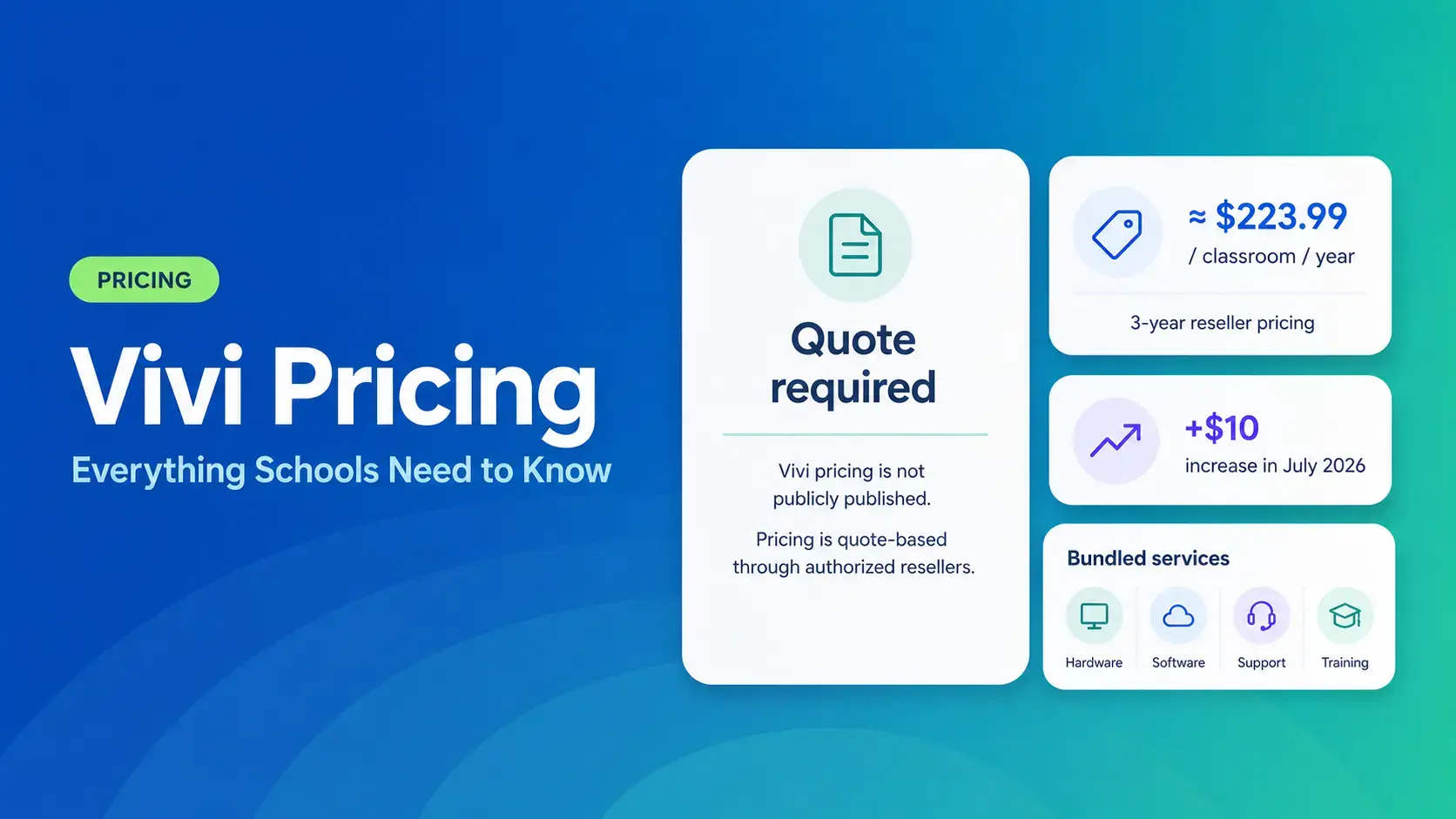
If you're budgeting for Vivi, expect to call sales for a number. Pricing isn't published anywhere. Reseller data puts the 3-year subscription around $224 per classroom per year. That rate rose by $10 in July 2026. Hardware, software, support, and training are all bundled in.
What Should You Know About Vivi Pricing Before Engaging Sales?
Pricing is only one part of evaluating a communications platform, but it's often the conversation that determines whether your school moves forward with it. Before you can recommend a new platform, you need a realistic sense of the cost, what drives that number, and whether it fits your budget.
This guide pulls together what's publicly available on Vivi's pricing so you can go into the sales conversation prepared.
Why Trust Us?
At Rise Vision, we’ve worked with schools making pricing decisions for years, and we know what IT directors and principals need to have locked down before a purchase gets approved. Here's how one Technology Director put it after making the switch:
“...We saw a cost savings by choosing Rise Vision over other options like Vivi, without compromising quality or functionality. When you combine the screen sharing and the digital signage options, it is an easy choice. Rise Vision has been a smart investment for our schools.”
— Eric Burt, Technology Director at West Fork CSD
By the end, you'll have a clearer picture of how Vivi's pricing works and what changed in 2026.
What You Should Know About Vivi's Pricing Model
Before you call for a quote, here's how Vivi's pricing actually works.
Vivi’s Subscription Structure
Vivi runs on an annual subscription per classroom or display. Its defining feature is how much that subscription covers. Hardware, software, support, training, warranty, and the cloud admin console are all bundled into a single price. When Vivi releases new features or firmware updates, those ship under your existing subscription too.
If a display box fails under warranty, replacement is covered. Commit to a multi-year term and your rate is locked in for the full duration.
Vivi’s July 2026 Price Increase
On July 1, 2026, Vivi raised subscription pricing by $10 per subscription per year across North America. New subscriptions and any renewals starting on or after that date are billed at the updated rate.
If your current contract is still active, your price holds through the end of your term. If you're on a prepaid multi-year agreement, that rate is locked for the full duration, and the increase only applies when you renew. Hardware replacements purchased on or after July 1 are available at a one-time cost of $129.
What Vivi's Pricing Model and Increase Mean for You
Here’s what Vivi's pricing model and price increase mean for you:
What to Budget For
Vivi doesn't publish pricing, but reseller listings give you a useful starting point. CDW, one of the largest US technology resellers, lists the Vivi Pro 3-year subscription at $223.99 per classroom per year on annual payments. A school with 30 classrooms is looking at roughly $6,720 per year at reseller list pricing. At 50 classrooms, that's around $11,200 per year.
Your direct quote from Vivi's team may look different. Treat this as a working range going into that conversation, not a final price.
What to Consider Before You Sign
The term length you choose affects what you pay per year. That $223.99 figure is based on a 3-year subscription. The figure may come down on a longer term, but that also means a longer lock-in.
That tradeoff matters more in K-12 than it might elsewhere. Enrollment shifts, building renovations, and technology refresh timelines are real variables that affect how many classrooms you're equipping and for how long. A 5-year prepaid deal locks in your rate, but it also locks in your commitment. It's worth running that against your district's budget cycle and planning timeline before you sign.
How Rise Vision's Pricing Compares to Vivi’s
With Rise Vision, you can run the numbers yourself. Here's a pricing breakdown:
Clear Pricing Tiers for Predictable Budgeting
With Rise Vision, you get simple pricing tiers, feature breakdowns, and both monthly and annual rates on one page. For K-12 schools, there are three options: Basic, Advanced, and Enterprise, each with a clear picture of what's included.
The Basic plan starts around $11 per month and $119 per display per year. That covers everything you need to run digital signage from day one, including:
- 750+ animated and customizable templates
- Content integrations with Canva, YouTube, and more
- Unlimited users
- Unlimited storage
- Scheduling and playlists
- Offline playback
- Technical support with a 1-business-hour response SLA
The Advanced plan, at $138 per display per year, is where emergency alerts come in. If your school needs CAP-compatible emergency notifications alongside deeper integrations, this is the tier. School-wide scheduling overrides and brand settings are here too. It's the natural fit for schools that need to manage both daily communication and safety from the same platform.
Enterprise, at $164 per display per year, adds screen sharing, classroom alerts, district-wide scheduling overrides, SSO via SAML, and a teacher-specific user role. For schools or districts that want one platform covering digital signage, emergency alerts, and wireless screen sharing across every room, this is the full picture.
One Flat Rate for Every Display in Your School
For schools managing a lot of displays, Rise Vision offers the K-12 Unlimited License at $1,399 per school per year. That's the full Enterprise feature set — screen sharing, emergency alerts, classroom alerts, district-wide scheduling, SSO, and a teacher-specific user role — for an unlimited number of displays and users, at one fixed price.
The break-even against per-display Enterprise pricing is around 9 displays. Past that, the Unlimited License is the better deal, and the gap widens as your school grows.
| Displays per School |
Enterprise (Per-Display) |
K-12 Unlimited |
| 5 |
$820/year |
$1,399/year |
| 9 |
$1476/year |
$1,399/year |
| 15 |
$2,460/year |
$1,399/year |
| 25 |
$4,100/year |
$1,399/year |
| 40 |
$6,560/year |
$1,399/year |
For districts managing multiple schools, it's also possible to have some schools on the Unlimited License and others on per-display pricing on one invoice.
One key difference between Rise Vision and Vivi is how hardware is priced. Rise Vision's pricing covers the software, so you can use hardware you already own or source whatever works best for your school. The platform supports ChromeOS, Windows, Amazon Signage Stick, Raspberry Pi, and more. Vivi includes hardware as part of its subscription, so it's helpful to compare the total cost of both.
So, Is Vivi Right for Your School?
If your school needs screen sharing, digital signage, and emergency alerts, Vivi covers real ground. For schools that need hardware as part of the deal, the all-inclusive subscription simplifies procurement.
The harder part is making the budget case before you've seen a number. If your district needs a figure to start the approval process, the sales-team-only model adds steps that most K-12 purchasing timelines don't have room for. With the July 2026 price increase now in effect, schools heading into a new contract or renewal should make sure their budget reflects the updated rate.
With Rise Vision, digital signage starts at $11 per display per month. The full platform — signage, screen sharing, and emergency alerts — is available for one flat annual rate of $1,399 per school per year with unlimited displays.
You can start with a 14-day free trial to see if it’s a good fit for your school. If you subscribe to any plan, you’re protected by a 30-day money-back guarantee.