
This is part three in our series on best practices for Presentations in Digital Signage with Rise Vision.
Use the Golden Ratio – Using the image referenced in this Forum discussion, all the boxes are sub-divided with the Golden Ratio and hence all elements in the Presentation can be made sizes in relation to one another. Very handy for Presentations being built at 1920 x 1080.
Digital Signage Layout
For hundreds of years, artists, architects, and designers have enlisted the Golden Ratio to create visually appealing works. In this post, I’ll explain the Golden Ratio, break down the layout for digital signage, and compare to the Rule of Thirds.

What is the Golden Ratio?
In order to understand why The Golden Ratio is desirable in visual design, let’s first understand the Golden Ratio. The Golden Ratio (also known as The Divine Proportion) states that the ratio of the sum of two numbers to the larger number is equal to the ratio of the larger number to the smaller number. The ratio is 1.62:1 Mathematically, it would look like this: (a+b)/a = a/b.
It has been long believed that the Golden Ratio is an aesthetically ideal design scheme because it’s a naturally recurring phenomenon. Because of this, there are ardent supporters of its usage as the optimal visual communication layout. While research has yet to definitively prove this, it has been used for hundreds of years in art and design, and is commonly found in the visual arts.
In design, the Golden Rectangle is often used as a template for applying the Golden Ratio.

The Golden Ratio is a very common website layout practice. You can see it with a lot of websites where there are two columns, such as this BMW example.
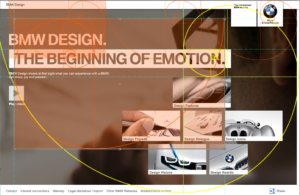
Let’s translate that to a TV screen. In the case of a 1920x1080 (16:9) screen, we’ll split the screen once:
So, using the Golden Ratio, the ratio of the the total span of the screen to the larger number is 1.62:1 (1,920:1,185). This is equal to the ratio of the larger span to the smaller span. 1,185:735 is 1.62:1.
1,920:1,185 = 1.62:1
1,185:735 = 1.62:1
Given digital signage’s capability to deliver several “zones” of information on a screen, the Golden Ratio layout can be applied to communicate in a visually appealing and effective manner when providing several pieces of information. Consider below where the same screen above is broken into three zones.
In this case, the largest zone would be the important information, while the second and third zones will have complementary or alternate information.
The Rule of Thirds
Another rule of composition is called the Rule of Thirds. This rule states that if you divide a composition into nine equal zones, that subjects of the composition should be placed on the lines or intersections. Advocates of the Rule of Thirds believe that placing subjects along these lines creates more energy in the image.

You can see how the edge of the river and land falls on the line,
with trees on lines as well.
This rule is much more apparent in a full screen composition, where the Golden Means can apply to breaking up the screen into zones.
When Do You Use The Golden Ratio or The Rule of Thirds?
A good place to start is determining what is on your screen. If you’re planning to create full-screen, single-image compositions, then the Rule of Thirds may be appropriate because the viewer does not have to work at interpreting several bits of separate information. If you plan to break your screen into several zones of information, consider that the general English-speaking method of reading is left-to-right, top-to-bottom. Applying the Golden Rule for zone size makes much more sense.
Looking for more tips on how to get the most out of your digital signage? Check out these resources below:
- Where to Place Your Digital Signage
- 101 Digital Signage Content Ideas
- Interactive Digital Signage Best Practices
- 20+ Google Slide Features You Might Not Use...But Should
More From Our Blog
-

Interactive Touch Screen Digital Signage: How It Works and What You Need
Interactive touch screen digital signage lets viewers tap a display to find what they need. It pairs a commercial touch display with content software. Common uses include wayfinding, visitor[…]
Read More -

Vivi Pricing 2026: Everything Schools Need to Know Before Getting a Quote
If you're budgeting for Vivi, expect to call sales for a number. Pricing isn't published anywhere. Reseller data puts the 3-year subscription around $224 per classroom per year. That rate rose by $10[…]
Read More -
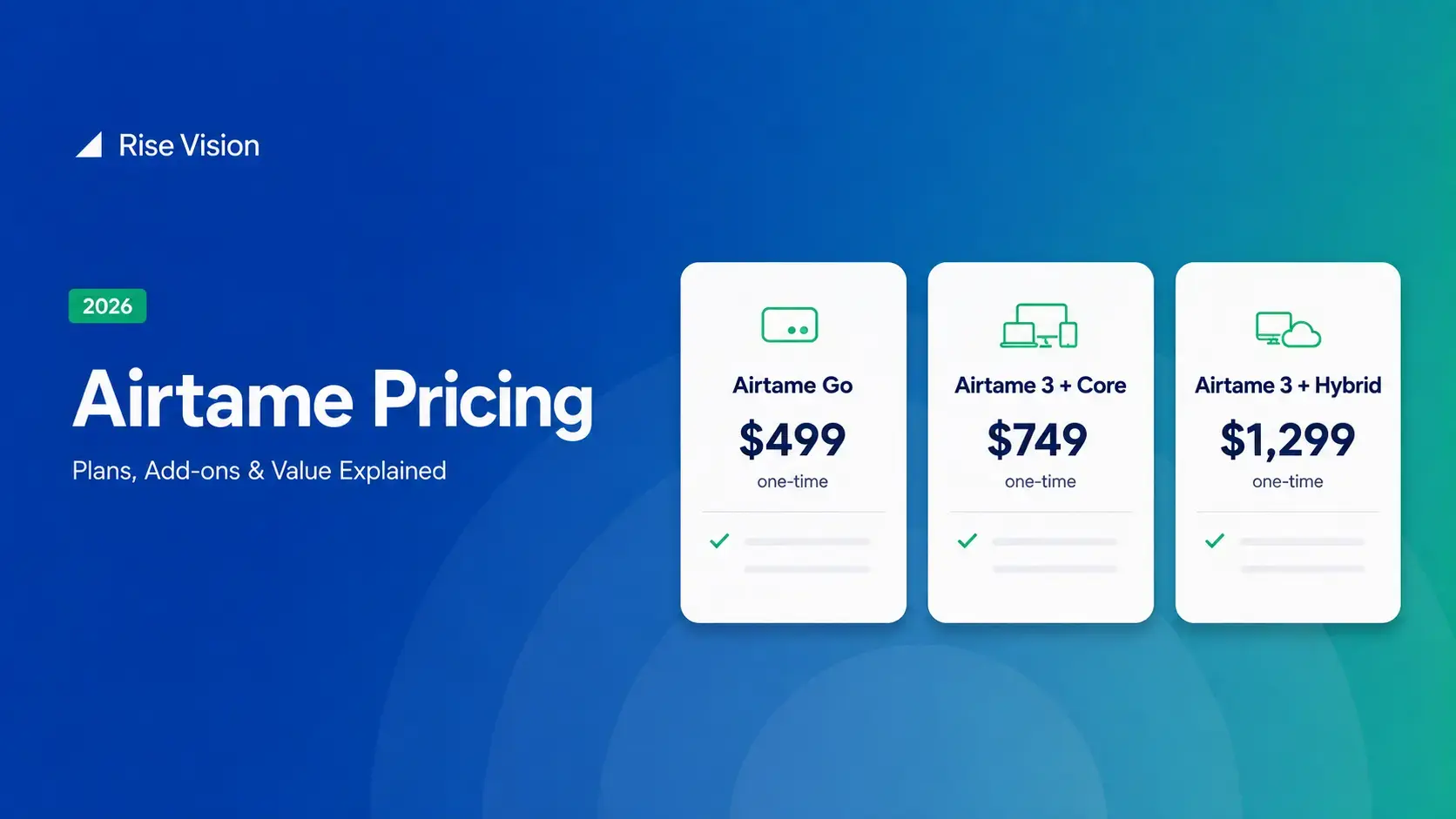
Airtame Pricing 2026: Plans, Costs & Renewal Fees
Airtame's 3-year bundles run $299 to $1,299 per display, then $120–$300/device/year to renew. Signage and alerts come standard on every tier, but only screen sharing survives if you skip renewal.[…]
Read More
12,300+ Organizations Trust Rise Vision, You Can Too
































Schedule a Free Demo
You deserve the #1 all-in-one platform for digital signage, screen sharing, and emergency alerts.